How to Calculate Calories in Cat Food Toppers (Without Overfeeding)
The short answer: To calculate calories in a cat food topper, find the kcal/kg figure on the package, divide it by 1,000 to get kcal per gram, then multiply by the number of grams you serve. For example, a freeze-dried topper at 4,200 kcal/kg served as a 10-gram sprinkle contains 42 calories. Keep toppers within the 10% treat budget — for a cat eating 250 calories a day, that’s no more than about 25 calories from toppers.
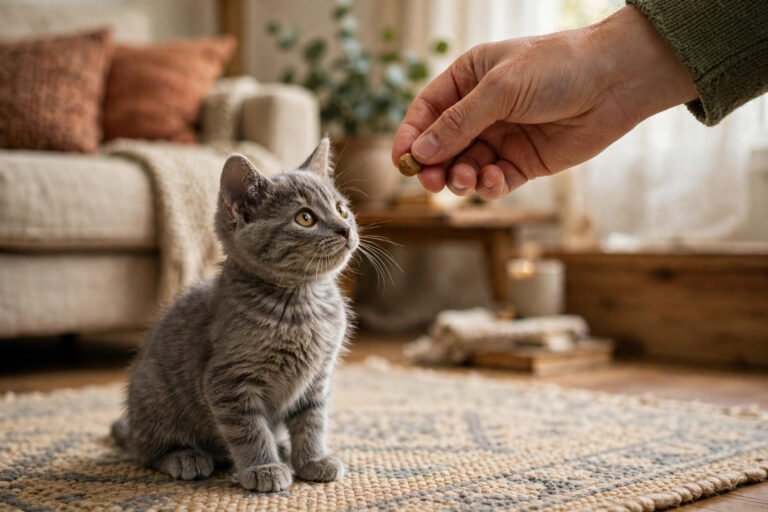
Food toppers are one of the easiest ways to make your cat’s dinner more exciting. A little sprinkle of freeze-dried chicken, a spoonful of shredded salmon, or a drizzle of bone broth can turn a boring bowl of kibble into something your cat actually looks forward to. They are also a lifesaver for picky eaters and for sneaking a bit of extra hydration into a dry-food diet.
The problem is that toppers are calorie-dense, and a “little sprinkle” is surprisingly easy to get wrong. A heaped tablespoon of freeze-dried raw can carry as many calories as a full treat stick, and most owners never count it. Do it daily and your cat quietly gains weight while you insist you are “feeding exactly the right amount”. The good news: once you know the one formula that matters, counting topper calories takes about ten seconds.
What Counts as a Cat Food Topper?
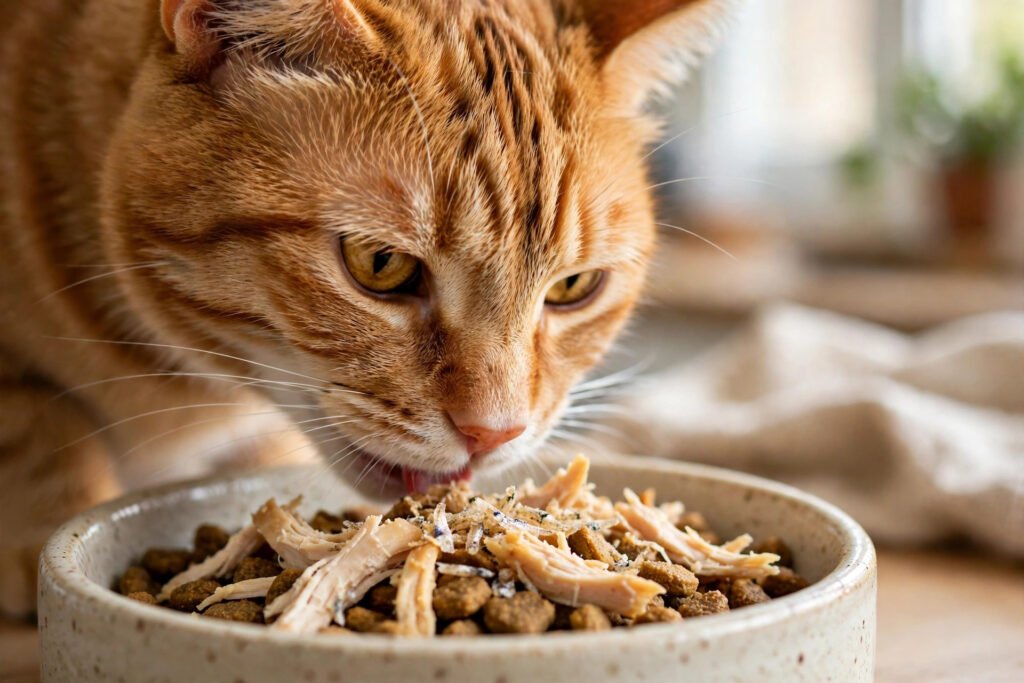
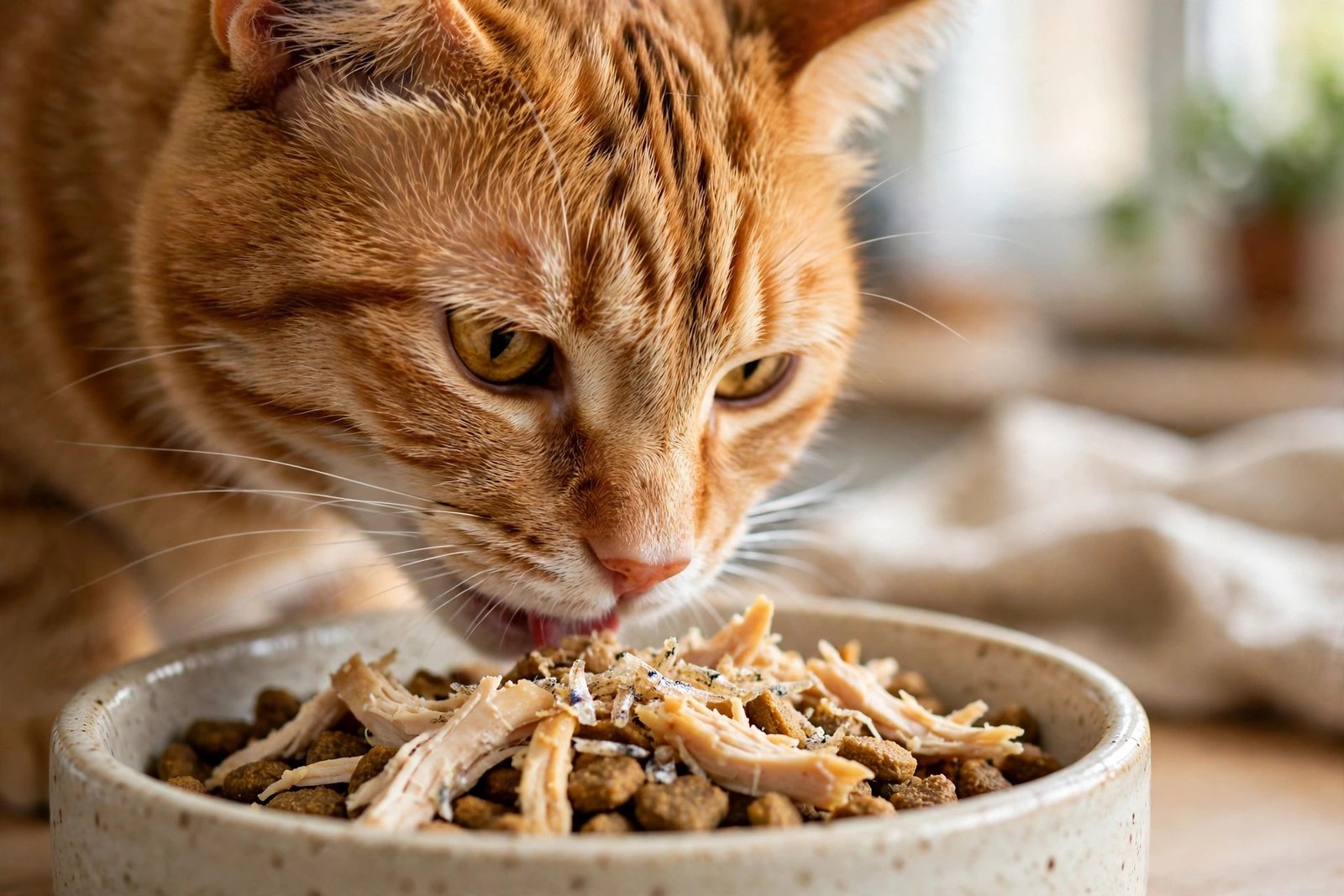
A topper is anything added on top of your cat’s regular meal in a small amount: freeze-dried raw bites, air-dried meat shreds, dehydrated fish flakes, wet-food “gravy” pouches sold as toppers, bone broth, goat’s milk, and even plain cooked chicken or fish you prepare at home. Some are sold specifically as meal enhancers; others are just treats used topper-style.
The line between a topper and a treat is blurry, which is exactly why both need counting. Your cat’s body does not care whether those calories arrived as a sprinkle on dinner or as a mid-afternoon snack — they all land in the same daily total. If you already track treat calories (and you should, since treats should stay within about 10% of daily intake), toppers sit in the same budget.
Step 1: Find the Calorie Figure on the Package
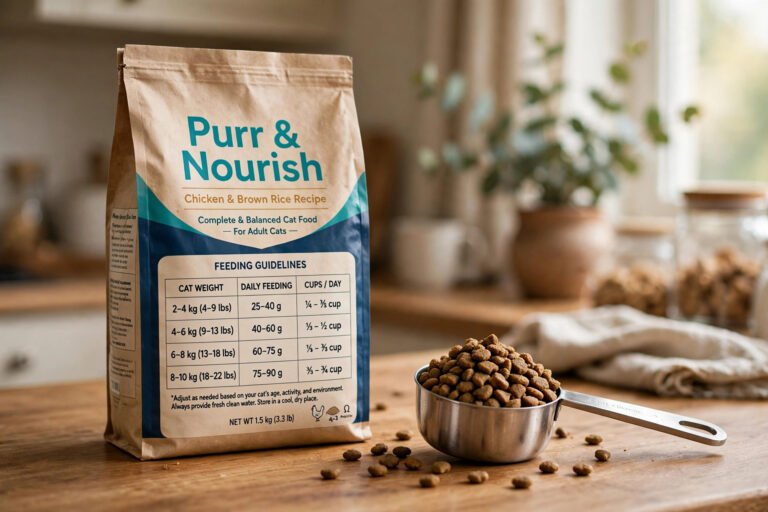
Start with the topper’s packaging or the manufacturer’s website and look for one of these numbers, in this order of preference:
- kcal per gram (kcal/g) — the easiest to work with, but the least commonly printed.
- kcal per kg (kcal/kg) — the most common figure on pet food labels worldwide.
- kcal per cup — sometimes given for dry-style toppers; less useful because “cup” is vague.
- kcal per piece or per serving — occasionally printed on single-serve topper pouches.
The number usually sits right under the guaranteed analysis panel or in the feeding-guidelines section. If it is not on the bag, check the product page online — reputable brands publish it. If you cannot find a calorie figure anywhere, treat that as a red flag and weigh the topper against your cat’s daily budget conservatively, or choose a brand that publishes its numbers.
Step 2: Use This Simple Formula
The core calculation is dead simple:
Calories in the topper = (kcal per kg ÷ 1,000) × grams served
Example: a topper labelled 4,200 kcal/kg, served as a 10-gram sprinkle:
(4,200 ÷ 1,000) × 10 = 42 calories
That is genuinely all there is to it. Divide by 1,000 converts the kilo-based figure into calories per gram, and multiplying by the grams you actually serve gives the calories in that serving.
Two things make this accurate rather than a guess: knowing the true kcal/kg figure, and weighing the portion. “A sprinkle” is not a measurement. If you want real numbers, put the bowl on a kitchen scale, zero it, and add the topper. After a week of weighing you will develop a feel for your usual sprinkle, but measure it at least once so your “usual” is based on fact.
Shortcut: Calories Per Gram
If you use the same topper daily, do the first part of the maths once and stick it on the fridge. A 4,200 kcal/kg topper is 4.2 calories per gram; a 3,500 kcal/kg topper is 3.5 calories per gram. From then on, calories are just grams × that number. A 7-gram sprinkle of the 4.2 kcal/g topper is 29.4 calories — quick enough to do in your head while feeding.
Worked Examples: Common Topper Types
Here are realistic worked examples showing how different toppers stack up. Calorie densities vary by brand, so always use your own package’s figure where possible — these are typical ranges.
| Topper type | Typical kcal/kg | Serving | Calories |
|---|---|---|---|
| Freeze-dried chicken bites | 4,200 | 10 g sprinkle | 42 |
| Air-dried meat shreds | 3,800 | 8 g handful | 30 |
| Dehydrated salmon flakes | 4,500 | 5 g dusting | 23 |
| Bone broth (liquid topper) | ~300 | 30 ml drizzle | ~9 |
| Wet “gravy” topper pouch | ~800 | 25 g pouch | ~20 |
Notice the spread: a light dusting of salmon flakes adds about 23 calories, while a generous sprinkle of freeze-dried chicken nearly doubles that. For a cat on a 250-calorie daily diet, that difference is the gap between a sensible 9% topper budget and a 17% one.
Homemade Toppers: Cooked Meat and Fish
Many owners top with plain cooked chicken, turkey, or white fish — cheap, healthy, and cats love it. These have no label to read, so use standard estimates:
- Plain cooked chicken breast: about 1.5 calories per gram (150 kcal per 100 g)
- Plain cooked turkey breast: about 1.2 calories per gram (120 kcal per 100 g)
- Plain cooked white fish (cod, haddock): about 1.0 calorie per gram (100 kcal per 100 g)
- Cooked salmon: about 2.1 calories per gram (210 kcal per 100 g) — delicious but calorie-dense
- Plain scrambled or boiled egg: about 1.5 calories per gram (150 kcal per 100 g)
These assume no added oil, butter, or seasoning — always serve homemade toppers plain. A 15-gram chunk of cooked chicken breast is roughly 22 calories, a perfectly reasonable topper portion for most cats. Just remember the same rule: weigh it, don’t eyeball it, at least until you know your portions.
Keep Toppers Inside the 10% Treat Budget
Nutritionists generally recommend that no more than 10% of a cat’s daily calories come from anything other than their complete and balanced main diet. Toppers, treats, table scraps, and the kibble your toddler drops on the floor all share this one budget. Here is what that budget looks like at common daily intakes:
| Cat’s daily calories | 10% topper + treat budget | What that looks like |
|---|---|---|
| 200 kcal (small / less active cat) | 20 kcal | A 5 g sprinkle of freeze-dried topper, nothing more |
| 250 kcal (average indoor cat) | 25 kcal | About 6 g of freeze-dried chicken bites |
| 300 kcal (larger / active cat) | 30 kcal | About 7 g of freeze-dried topper or 15 g wet gravy topper |
The takeaway is humbling: one generous sprinkle can swallow most of the budget on its own. That does not mean skipping toppers — it means counting them, and trimming the main meal slightly on heavy topper days. Reducing the kibble by the topper’s calorie equivalent keeps the daily total exactly where it should be. Our free cat feeding calculator can help you work out the right base portion once you know your cat’s daily calorie needs.
Three Mistakes That Quietly Add Weight
1. Double-counting “zero” toppers
Broth and watery gravy toppers feel like they cannot possibly matter — but 30 ml of bone broth is around 9 calories, and doing it twice a day plus treats adds up to a meaningful surplus over weeks. Light does not mean free.
2. Serving by eye every time
Studies on pet owners consistently show we overestimate small portions. What you think is 8 grams of freeze-dried bites is often 12–14. A cheap kitchen scale is the single best purchase you can make for accurate feeding — it pays for itself in kibble you stop wasting.
3. Forgetting the topper when reducing food
If your cat is gaining weight and you cut the main meal by 10% but keep the topper habit, the real cut is smaller than you think. When adjusting portions, put everything in the bowl on the scale, topper included.
Frequently Asked Questions
Do I need to count calories in toppers if I only use a tiny bit?
Yes — even a tiny bit has calories, and “tiny” is easy to misjudge. Counting does not need to be obsessive: weigh your usual sprinkle once, note the calories, and reuse that number daily. Thirty seconds of effort gives you accuracy for months.
Are meal toppers healthier than treats?
Often, yes. Single-ingredient toppers like freeze-dried meat are usually less processed than shaped treats and add palatability and moisture to the meal. Nutritionally they are comparable, though, which is why they share the same 10% calorie budget.
Can kittens have toppers?
Yes, but kittens have higher calorie needs per pound and are growing fast, so the 10% guideline still applies to their (larger) daily total. Keep portions small and stick to age-appropriate, plain ingredients — avoid anything with added salt, onion, or garlic.
What if my topper has no calorie information?
Check the manufacturer’s website first — the figure is often published there even when it is missing from the bag. If you genuinely cannot find it, assume a freeze-dried meat topper is around 4,000 kcal/kg as a working estimate, and consider switching to a brand that publishes its numbers.
The Bottom Line
Calculating topper calories is one easy formula: kcal per kg, divided by 1,000, times grams served. Weigh your sprinkle once, do the maths once, and you will know exactly where you stand. Toppers are a wonderful way to keep mealtimes interesting — as long as they stay inside that 10% budget, your cat gets all the fun with none of the creeping weight gain.
Discussion