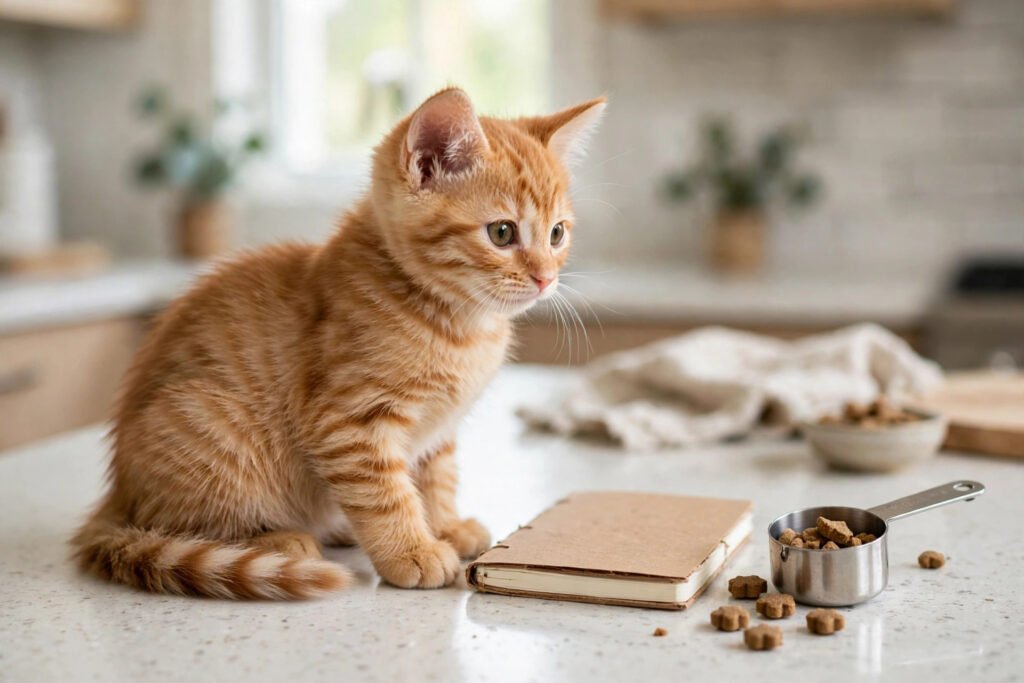
It is easy to count the calories in your cat’s main meals and still end up overfeeding. The culprit is rarely the bowl — it is the handful of treats handed out through the day: one for coming inside, one for taking a tablet, one because those eyes are impossible to resist. None of them feels like much on its own, yet together they can quietly push a cat well past its daily calorie target. Learning how to track cat treat calories throughout the day is the simplest way to keep treats enjoyable without letting them unbalance the whole diet.
Quick answer: Treats should make up no more than 10% of your cat’s daily calories, and the rest should come from complete food. Work out your cat’s daily calorie target, set aside a treat budget of up to 10% of it, note down every treat as you give it, and stop when the budget is spent. A kitchen notebook, a phone note, or a simple tally on the fridge all work — the method matters far less than doing it every single day.
Start with the daily calorie target
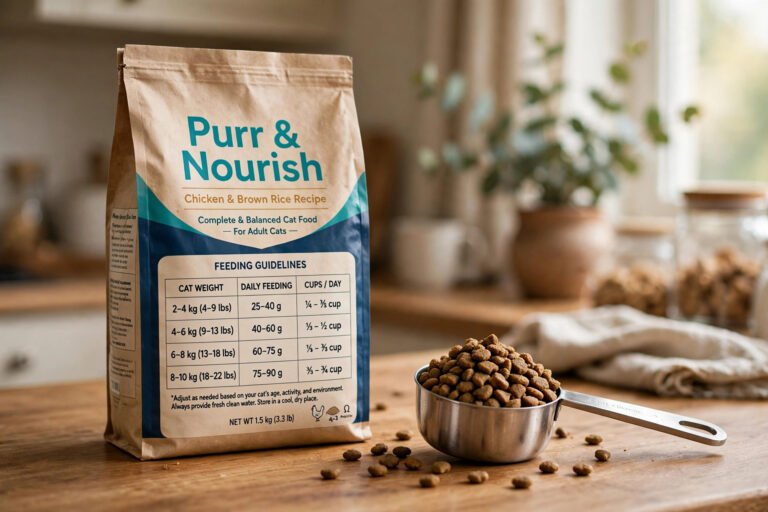
You cannot track treat calories sensibly until you know the total you are tracking against. An average indoor adult cat weighing around 4 kg typically needs roughly 200 to 250 calories a day, but the real figure depends on weight, age, activity level, and whether the cat is neutered. Your vet can give you a precise target, and a good starting point for the maths is our cat calorie calculator, which estimates daily needs from your cat’s weight and lifestyle.
Once you have the total, the treat budget is simple: 10% of it. For a cat on 220 calories a day, that is 22 calories of treats — roughly two or three small commercial treats, or a single larger dental chew. Writing that number down somewhere visible is the whole trick. When the budget is a vague idea in your head, it gets spent twice over; when it is a number on the fridge, everyone in the house can see it.
Find the calories in each treat
Commercial treats in the UK and EU must state their energy content on the pack, usually as kilocalories per 100 grams (kcal/100 g) and sometimes per piece. If only the per-100 g figure is given, divide it by the number of treats in 100 g — or weigh a small sample. For example, a treat at 350 kcal per 100 g that weighs about 2 g per piece contains roughly 7 kcal each. Three of those use up almost the entire daily treat budget of our example cat.
Homemade treats need a little more detective work. A small piece of cooked chicken breast (about 10 g) contains roughly 16 kcal; a similar piece of cheese contains around 40 kcal, which is why cheese should be an occasional treat rather than a daily one. Freeze-dried meat treats are concentrated: because the water has been removed, a tiny piece can carry more calories than it looks like it should. Weighing treats for the first week, even roughly, trains your eye surprisingly quickly.
Pick one tracking method and stick to it
The best tracking system is the one you will actually use. Three approaches work well for most households:
1. The daily jar method. Each morning, put that day’s treat allowance into a small jar or pot. Treats come only from the jar, and when it is empty, treats are finished for the day. This method is brilliant in multi-person households because it stops the classic problem of every family member giving “just one” treat. It also works beautifully with children, who can see the jar emptying and learn portion sense.
2. The tally method. Keep a small notepad or a phone note by the treat cupboard. Every time anyone gives a treat, they write the treat type and the running calorie total. This method suits cats on mixed treats — dental chews in the morning, a lick treat in the evening — because it records calories rather than pieces.
3. The meal-adjustment method. If you know you will give a high-value treat — for example, a lick paste to hide medication — subtract its calories from the next meal in advance. A 20 kcal treat means serving about 20 kcal less food at dinner. This keeps the day’s total steady without banning the treat the cat actually needs.
Watch out for the hidden treat calories
Not everything that counts as a treat looks like one. Lick pastes and squeeze treats typically contain 10 to 20 kcal per tube. Dental chews can contain 25 to 35 kcal each — more than a whole day’s treat budget for a small cat. Food used for training counts too: ten tiny training treats at 3 kcal each add up to 30 kcal, which is already over budget for many cats. Even a spoonful of wet food offered as a “topper” or bribe is treat calories if it sits on top of the normal meal rather than replacing part of it.
Table scraps deserve a special mention. A small piece of ham, a lick of gravy, or a flake of fish from your plate all carry calories, and salty or seasoned human food can also upset a cat’s stomach. If you do share a little cooked, unseasoned meat, log it like any other treat.
A worked example: a day in treats
Take Miso, a 4.5 kg indoor cat whose daily target is 230 kcal. Her treat budget is 23 kcal. Her day might look like this:
| When | Treat | Calories | Running total |
|---|---|---|---|
| Morning | 2 small crunchy treats (4 kcal each) | 8 kcal | 8 kcal |
| Midday | 1 dental chew | 12 kcal | 20 kcal |
| Evening | 1 tiny piece of cooked chicken | 3 kcal | 23 kcal |
By evening, Miso has enjoyed three treat moments and stayed exactly on budget. Without tracking, the same day could easily have included a second dental chew and a squeeze treat — adding another 30 kcal, or roughly 13% over her daily target. Repeated daily, that surplus is what slowly turns a healthy cat into an overweight one.
What to do when the budget runs out
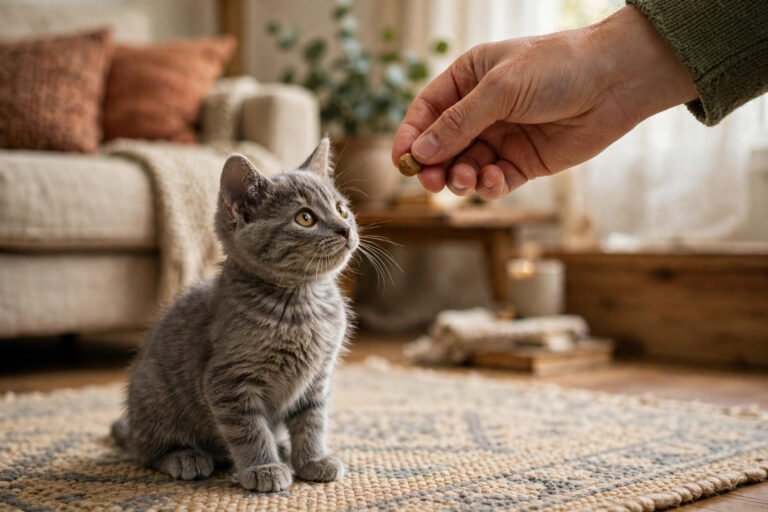
Running out of treat calories does not mean running out of ways to reward your cat. Most cats value attention, play, and novelty at least as much as food. A two-minute play session with a wand toy, a brushing session, a fresh cardboard box, or a sprinkle of catnip on a scratcher all work as rewards and cost zero calories. For cats that are strongly food-motivated, you can also “pay” with kibble taken from their next meal: set aside ten pieces of their normal food in the morning and use those as training rewards through the day. The calories were already in the day’s plan, so nothing extra is added.
Adjusting the budget over time
Treat tracking is not a one-time calculation. Kittens, pregnant cats, and very active outdoor cats need more calories overall, so their treat budget is larger in absolute terms — though the 10% rule still applies. Older cats and neutered indoor cats usually need fewer calories, so their budget shrinks. If your cat is gaining weight despite tracking, the first thing to check is whether every treat is genuinely being logged: the most common leak is a family member who does not know the system exists. The second thing to check is the main meals — a measuring scoop that has drifted, or a food change to a more calorie-dense recipe, can quietly add calories that no amount of treat tracking will fix.
Weigh your cat monthly and keep a short note of the trend. A stable weight with a happy, active cat is the sign the system is working. Slow weight gain means trimming the budget by a few calories or tightening up the logging; weight loss in a cat that is not meant to be losing weight is a reason to talk to your vet rather than simply adding treats back.
Common mistakes to avoid
The most frequent error is counting pieces instead of calories. Ten tiny treats and two large chews are not equivalent, even though the chew count looks smaller. The second error is forgetting liquid treats and pastes, which are easy to squeeze out without thinking. The third is treating the 10% rule as a target rather than a ceiling — cats do not need treats every day, and a day with no treats at all is perfectly fine. Finally, avoid “borrowing” from tomorrow: a cat that gets double treats today and none tomorrow still had an unbalanced day, and the habit of borrowing tends to become permanent.
The bottom line
Tracking cat treat calories throughout the day comes down to three habits: know the daily target, know the treat budget (10% of that target), and write treats down as you give them. The jar method makes it effortless in busy households, the tally method suits mixed treats, and adjusting the next meal keeps special treats affordable. None of these methods takes more than a minute a day, and together they protect the one thing that matters most: a cat that enjoys its treats and stays a healthy weight while doing so.
Discussion