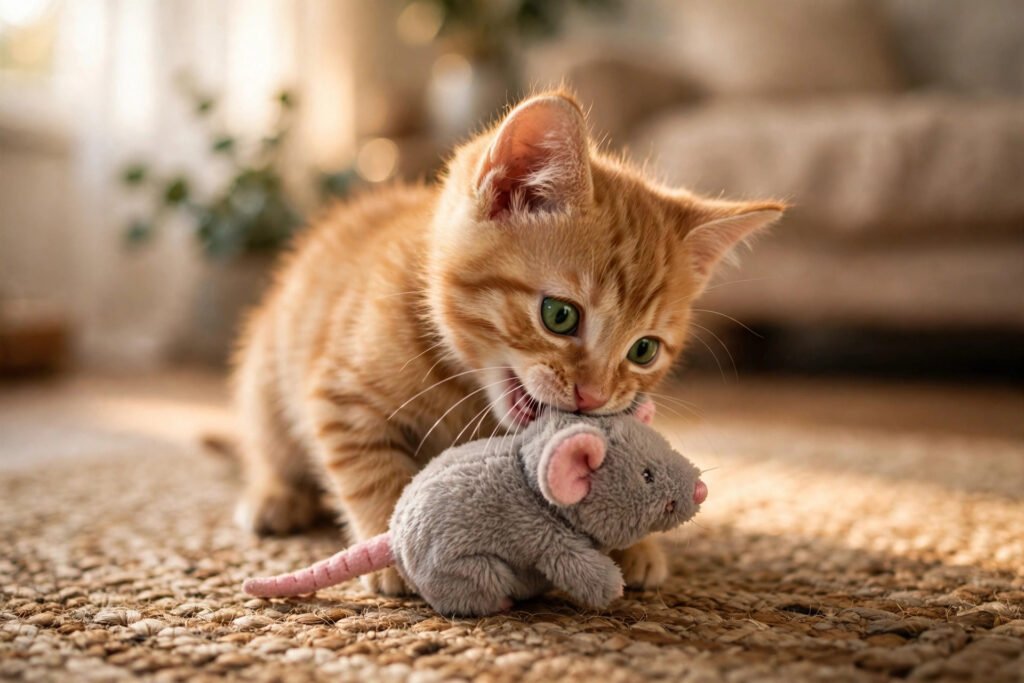
Your kitten is lying on your lap, purring like a tiny engine, and then — chomp. Teeth in your finger. You yelp, the kitten looks delighted, and you wonder whether you’ve accidentally adopted a miniature vampire. Relax: biting is one of the most normal things a kitten does. It is also one of the most fixable, as long as you understand which kind of bite you’re dealing with and respond the right way.
Not all kitten bites mean the same thing. A playful nip during a game, a fearful bite from a cornered kitten, and an overstimulation bite after too much stroking are three completely different behaviours that need three completely different responses. Treating them all the same is where most people go wrong.
Why kittens bite in the first place
Biting is how kittens explore and learn. In a litter, kittens learn bite control from their siblings: when one bites too hard, the other squeaks and stops playing. Over weeks of this, the kitten learns exactly how much pressure is acceptable. It’s called bite inhibition, and it’s the foundation of every gentle adult cat.
Kittens removed from their litter very young, or singletons raised without siblings, often miss chunks of this education. They arrive in your home with teeth they don’t quite know how to use — and you’re the new sibling.
Teething plays a part too. Kittens lose their baby teeth at around three to four months, with adult teeth in by about six months. Chewing and mouthing soothe sore gums, like a teething baby with a teether.
The three kinds of kitten bite
1. Play biting
This is the classic: the kitten ambushes your ankles, wrestles your hand, or latches onto your fingers during play. Ears forward, body loose and bouncy, tail up or twitching with excitement. Play biting is almost always aimed at hands and feet, during or right after active play.
Most play biting comes from the humans, not the kitten. Hands are irresistible — they move, they’re warm, they’re right there. If every game involves your fingers darting around like prey, your fingers become prey.
2. Fear or defensive biting
This one looks completely different. The kitten is cornered, held against its will, or startled — ears flattened, body low, pupils huge, maybe hissing first. The bite comes fast and hard, and the kitten wants to escape, not to play. This is a bite of last resort: the kitten tried to say no with body language, and biting was the only message that worked.
Fear biting is common in newly adopted kittens and kittens in noisy, chaotic situations. Never punish it — the kitten is terrified, and punishment teaches it that people really are as scary as it thought.
3. Overstimulation biting
You’re stroking the kitten, it’s purring, everything’s lovely — and then it turns and bites your hand. There usually was a warning you missed: a tail that started flicking, skin rippling along the back, ears rotating sideways. This is the classic “petting-induced” bite, and it catches nearly every new cat owner at least once.
Overstimulation bites aren’t aggression. The kitten simply hit its limit for handling. Every cat has a different limit — some tolerate an hour of stroking, others tap out at thirty seconds.
Biting by age: what’s normal when
Under 8 weeks: Mouthing everything, barely any bite control. Kittens this young shouldn’t really be away from their litter yet.
8–12 weeks: Peak play-biting season — the most important window for teaching gentle play.
3–6 months: Teething overlaps with high energy. Biting may spike as adult teeth come in; chew toys become essential.
6–12 months: Most kittens naturally tone down the biting as they mature, provided the humans have been consistent. Adolescent cats that still bite hard usually missed consistent feedback earlier.
How to stop play biting: redirection, not punishment
The number one rule: hands are not toys. This is the single most effective change you can make. If your fingers have been the main attraction, the kitten has learned that skin equals playtime. Break that association completely.
- Redirect to a toy every single time. Keep a wand toy or kicker toy within arm’s reach. The moment teeth touch skin, go still — a frozen hand is boring — then swap in the toy and praise the kitten for attacking that instead. Everyone in the house must be consistent.
- End the game on a bite. Let out a short, sharp “ow” — not a scream, just a clear signal — then withdraw your hand and stop playing for a minute. This mirrors what littermates do, and it’s the language kittens understand best.
- Schedule real play sessions. Two or three structured sessions a day, ten to fifteen minutes each, with a wand toy that keeps your hands far from the action. End each session by letting the kitten “catch” the toy, then offer a small meal — hunt, catch, eat, sleep is the natural cycle. A kitten with its energy properly spent has far less interest in your ankles.
- Provide chew options. Teething kittens need things to bite that aren’t you: crinkly toys, small stuffed kickers, even a clean, damp flannel knotted up for sore gums.
- Don’t wrestle with your hands. It’s funny when the kitten is eight weeks old and weighs half a kilo. It’s considerably less funny at eight months with claws out. What you allow now is what you’ll get later.
A second kitten is genuinely one of the best cures for play biting. Two kittens teach each other bite inhibition around the clock in a way no human can replicate. If you’re in a position to adopt a pair, the biting problem often solves itself within weeks.
How to handle fear biting
Fear biting is never solved with discipline — only with trust. Give the kitten escape routes and hiding places, and stop doing the thing that triggers the bite. If the kitten bites when picked up, stop picking it up for a while and let it come to you.
For a new kitten, keep the first days quiet and small: one room with a hiding spot, food, water and a litter tray. Sit on the floor and read a book. Let curiosity do the work — most kittens investigate a calm, still human within a day or two.
How to handle overstimulation biting
This one is about learning to read the warning signs and quitting while you’re ahead. Watch for the tail starting to flick, the ears tipping sideways, the skin rippling, or the purring stopping suddenly. Those are your two-minute warning.
Keep early stroking sessions short — a few strokes, then stop before the kitten has to ask you to. End on a good note and the kitten learns that cuddles are safe. Many owners find the cheeks and chin are tolerated far longer than the back or belly. The belly, tempting as it looks, is a trap for most cats — it’s the most vulnerable area, and a belly rub invitation is often a play invitation, claws included.
What never to do
Some advice on this topic is old, wrong, and makes things worse. Avoid all of the following:
- Don’t hit, flick or tap the nose. It doesn’t teach anything except that hands are scary. A fearful cat bites more, not less.
- Don’t yell or scream. Loud punishment startles and stresses the kitten. A short, sharp “ouch” to mark a bite is communication; shouting is just frightening.
- Don’t use spray bottles or squirt guns. They create a cat that’s afraid of you, not a cat that understands biting is wrong. The behaviour just moves underground — the kitten bites when you’re not looking.
- Don’t scruff an older kitten. Mother cats carry tiny kittens by the scruff; humans grabbing a six-month-old by the neck is painful and frightening, not maternal.
- Don’t pull your hand away fast. Jerking away triggers the prey instinct and makes the kitten grip harder. Go still, then redirect.
- Don’t isolate the kitten as punishment. Locking a kitten in a room alone after a bite teaches nothing except loneliness. A brief pause in play is feedback; exile is just confusion.
When biting signals a vet visit
See a vet if biting appears suddenly in a previously gentle kitten, if the kitten bites or cries when touched in one particular area, or if biting comes with other changes like hiding, not eating or limping. And clean any bite that breaks your skin thoroughly — cat bites can carry bacteria deep into tissue, so see a doctor if redness or swelling worsens.
Quick answers to common questions
Will my kitten grow out of biting?
Mostly, yes — with guidance. Kittens naturally develop better bite inhibition as they mature, but they need consistent feedback to learn where the line is. A kitten whose biting is ignored will become an adult cat that still bites.
Should I get another kitten to stop the biting?
It genuinely helps, often dramatically — kittens teach each other what humans can’t. But adopt a second kitten because you want one, not purely as a behaviour tool. The commitment is fifteen-plus years, not a training aid.
Why does my kitten bite my ankles specifically?
Because ankles move past at floor level, exactly like prey. Wear slippers, redirect with a toy, and schedule more active play — ankle ambushes are usually a sign of an under-exercised kitten.
Is it okay to let the kitten chew my fingers gently?
It’s tempting, and gentle mouthing from a young kitten feels harmless. But it teaches the kitten that fingers are acceptable chew toys, and “gentle” rarely stays gentle as the kitten grows. Redirect to a toy from day one — future you will be grateful.
My kitten bites during cuddles but purrs the whole time. Why?
That’s classic overstimulation — the purring doesn’t mean “keep going,” it can just be part of the whole sensory overload. Learn the early warning signs (tail flicking, skin rippling) and end cuddle sessions before the bite happens.
How long does it take to stop the biting?
With consistent redirection and proper play, most kittens show clear improvement within two to four weeks. Fear-based biting takes longer because trust builds slowly — think in months, not days, and celebrate small wins.
Biting is a phase, not a personality. Stay consistent, keep your hands out of the game, give the kitten proper outlets for all that hunter energy, and you’ll end up with a cat that plays gently and cuddles on your terms. If you want a structured approach to the whole thing — play, biting, scratching and all — a cat training plan generator can map it out week by week so you’re not guessing.

[…] also play rough and nip. Our guide on why kittens bite and how to stop it explains how to redirect […]