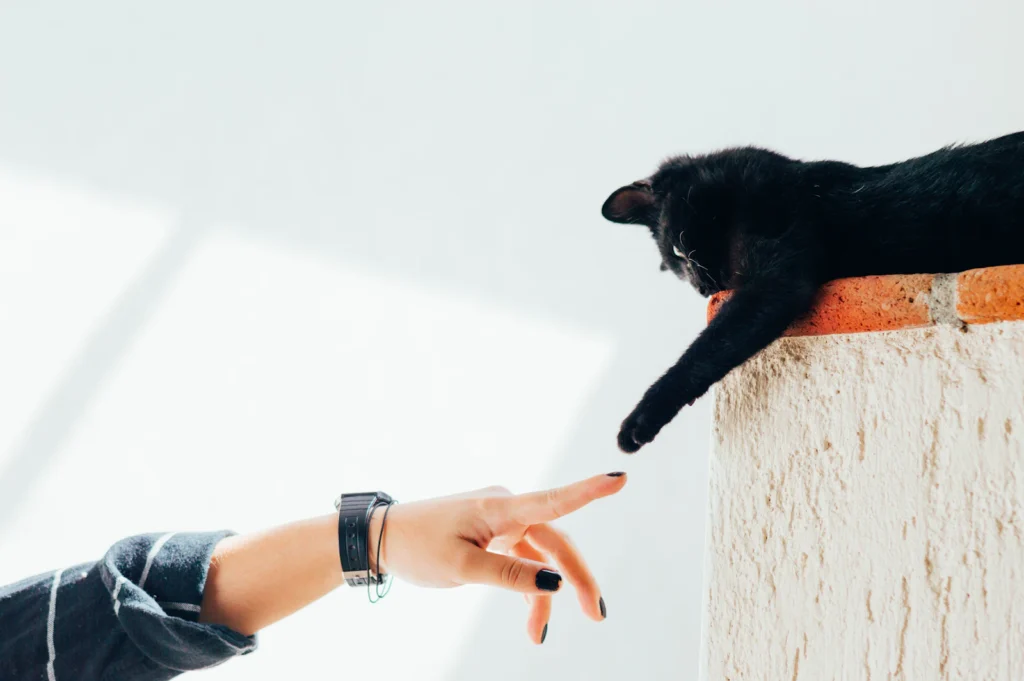
To teach a cat to high five, hold a flat hand just above and in front of your cat’s head, wait for them to reach up and touch it with a paw, then click or say “yes” and give a treat straight away. Repeat in short sessions, and add the words “high five” only once your cat touches your hand every time. A playful, food-motivated cat can learn it in a few short sessions.
High five is one of the easiest tricks for cats, because they naturally bat at things in front of them. It is also a great confidence builder and a gentle way to get your cat used to having their paws near your hands. If you want to fit it into a wider routine, our cat training plan generator builds a simple weekly plan for your cat.
What you need
- A marker. A clicker is ideal. Greater Good’s Cat Pawsitive guide notes you can also use a tongue click, a click-top pen or a short word like “yes”.
- Tiny, tasty rewards. Use something your cat loves, such as small pieces of cooked chicken, a lick of wet food from a spoon, or a lickable treat. Greater Good suggests choosing whatever your cat finds most rewarding, which might be food, a toy or attention.
- A quiet room. The Potter League guide suggests training in a room your cat already likes, such as a bedroom, to cut down distractions.
- The right timing. Train just before a meal or during your cat’s active play time, when they are alert and a little hungry.
Hold the clicker in your pocket or behind your back. Greater Good warns that a click right next to your cat’s face can startle them.
If your cat has never done clicker training before, start with our guide on how to clicker train a cat. It takes only a few minutes to teach your cat that the click means a treat is coming.
Step-by-step: how to teach a cat to high five
- Get into position. Sit or kneel in front of your cat so you are at their level.
- Present your hand. Hold a flat palm just above and in front of your cat’s head, within easy reach of a front paw.
- Wait. Keep your hand still. Most cats will sniff it, then lift a paw to touch it. This may need a little patience.
- Mark and reward. The moment the paw touches your palm, click or say “yes”, then give a treat immediately.
- Reset and repeat. Take your hand away, wait a few seconds, then present it again. Greater Good suggests about 10 repetitions per round.
- Shape it if needed. If your cat does not touch your hand, reward smaller steps. The Potter League guide suggests clicking first for lifting a front leg, then for any paw movement towards your hand, then only for the touch.
- Add the cue. Once your cat touches your hand every time, say “high five” as the paw lands. After a session or so, start saying it just before you show your hand.
- Practise in new places. Try it in different rooms and with other family members so your cat learns the trick, not just the setting.
The San Diego Humane Society shortcut
The San Diego Humane Society uses a slightly different route that works well for cats who are already keen on hand targeting:
| Step | What you show | What you reward |
|---|---|---|
| 1 | An open fist near your cat | Nose or paw touching your hand |
| 2 | A closed hand with a treat inside | Nosing or pawing at the hand |
| 3 | An open palm held up in high-five position | A paw touch on the palm |
| 4 | The palm plus the words “high five” | A paw touch on cue |
If your cat already knows how to touch a target, the jump to high five is small. See how to teach a cat to touch a target.
How long it takes
The San Diego Humane Society says a playful, food-motivated cat can often learn high five in 20 to 30 minutes of total training time. It suggests splitting that into three to five sessions of around 10 minutes, with breaks in between.
The Potter League guide recommends even shorter sessions, of no more than two minutes or 10 treats at a time. Short, frequent sessions suit most cats best, so stop while your cat is still keen.
| Cat type | Suggested session | How often |
|---|---|---|
| Keen, food-motivated cat | Up to 10 minutes | 1–2 times a day |
| Easily distracted cat | 2 minutes or 10 treats | 2–3 times a day |
| Kitten | 1–2 minutes | Several short bursts a day |
| Older or less active cat | 2–3 minutes | Once a day |
Watch the treat calories
Training uses lots of small rewards, and they add up. Use tiny pieces, about the size of a pea or smaller, and take them from your cat’s daily food allowance where you can. Our guide on how many calories cat treats should make up per day explains how to keep treats in balance, and the cat calorie calculator shows your cat’s daily needs.
Troubleshooting
| Problem | Likely cause | What to try |
|---|---|---|
| Cat ignores your hand | Hand too high or too far away | Lower it and bring it closer |
| Cat sniffs but will not lift a paw | Expecting food from the hand | Reward any leg lift to start |
| Claws come out | Excitement | Hold still and wait for claws to retract, then reward, as the Potter League guide suggests |
| Cat wanders off | Session too long or not hungry enough | Shorter sessions, before a meal |
| Cat grabs your hand | Treat-seeking with both paws | Reward only gentle single-paw touches |
| Touch is too fast to mark | Quick cat | Watch the shoulder; mark as the paw lands |
What not to do
- Do not pick up or push your cat’s paw onto your hand. The trick should be your cat’s choice. Guiding the paw makes many cats uneasy and slows learning.
- Do not add the cue too early. The Potter League guide advises waiting until your cat offers the touch reliably before saying “high five”.
- Do not train for too long. Long sessions lead to bored or frustrated cats.
- Do not move your hand towards your cat. Keep it still and let your cat come to you.
- Do not scold mistakes. Simply reset and try again. Training should always feel like a game.
Tricks to teach next
Once high five is solid, you can build on it:
- Wave. Hold your hand a little higher and reward the paw lift before it touches, gradually rewarding a higher lift with no touch.
- Sit and high five. Ask for a sit first, then the high five. Our guide on how to teach a cat to sit covers the first part.
- Come and high five. Call your cat over, then reward with a high five game. See how to train a cat to come when called.
Why teaching tricks is worth it
High five might look like a party trick, but the training behind it has everyday benefits:
- Mental exercise. Working out what earns a reward keeps your cat’s brain busy, which helps indoor cats in particular.
- Easier handling. A cat used to calm paw contact with your hand may find claw trims a little less strange. Our guide on how to trim your cat’s claws safely explains the next steps.
- A stronger bond. Short, positive sessions give you a fun way to spend time together every day.
- A building block. Once your cat understands that touching your hand earns a reward, other tricks come faster.
Tips for kittens
Kittens learn quickly but have short attention spans. Keep sessions to a minute or two and stop after a few successful touches. Kittens also tend to swat with claws out during play, so reward only gentle, soft-pawed touches. If your kitten gets bitey, end the session calmly and try again later.
Frequently asked questions
Can any cat learn to high five?
Most cats can, because pawing at things in front of them is natural behaviour. Food-motivated, playful cats tend to learn fastest, but calm, patient practice works for shy cats too.
Do I need a clicker to teach high five?
No. A clicker helps with timing, but a short word like “yes”, said the instant the paw touches, works too.
How long does it take to teach a cat to high five?
Many cats learn the basics in 20 to 30 minutes of total practice, spread over several short sessions.
What treats are best for training?
Small, soft, strong-smelling treats your cat loves, such as tiny pieces of cooked chicken or a lick of wet food. Keep pieces very small.
Why does my cat use claws when giving a high five?
It usually means excitement. Hold your hand still, wait for the claws to go in, then reward. Over time your cat will learn that soft paws earn the treat.
Discussion